





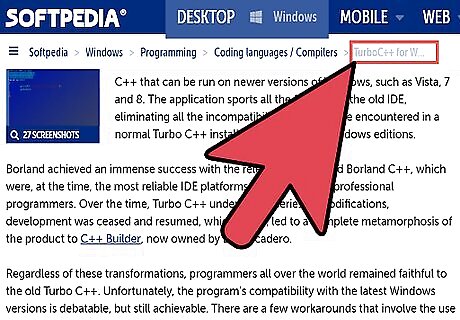
Program listing one below. int main() {struct STUDENT{int rollno;char stdname[20];float percentage;} *s1;printf("\Enter student details: ");scanf("%d %s %f",&s1->rollno,s1->stdname,&s1->percentage);printf("\nThe entered details are: ");printf("Roll: %d, Name: %s, Percentage: %f ",s1->rollno,s1->stdname,s1->percentage);getch();return 0;} The above C program is written and compiled in Turbo C. When this program is executed, the compiler displays the following error, Scanf: floating point formats not linked and the program gets terminated abnormally. This happens because of the variable *s1, which is a pointer to the structure "STUDENT", in which programmer had defined a "float" variable named "percentage". It means an error was found when the program tried to read a value for float data type using a pointer to structure. When the program is executed, the compiler, displayed a runtime error at the line scanf ("%f", ... %s1->percentage). It can happen when we use Borland C/ C++ or TurboC/C ++ as compiler. "Floating point formats not linked" is a Borland runtime error (Borland C or C++, Turbo C or C++). Borland's compilers do not link in the floating-point (f-p) library unless we need it. Therefore, by force we need to add any floating-point (f-p) function when we have "%f" or other floating point (f-p) formats in scanf() or printf() calls.
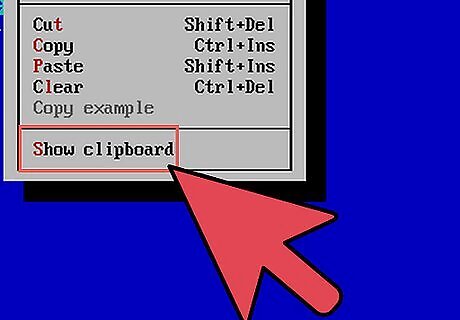
To fix this error, call a floating-point (f-p) function or just add link of a file, which contains at least one floating-point (f-p) function. To do this, a hackish solution could be to define a dummy function somewhere in a source file but don't call it: void dummy(float *a) {float b=*a; //perform some floating accessdummy (&b); //calling a floating point function} It doesn't have to be in a module with the main program, as long as it's in a module that will be included in the link. Therefore, the above program should be written as follows:
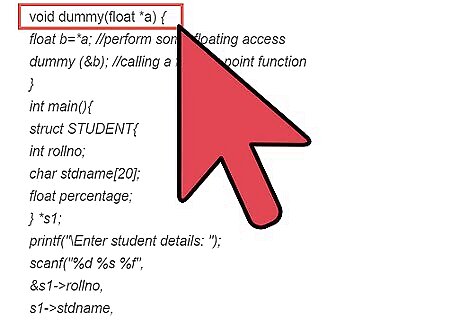
Program listing two below. void dummy(float *a) {float b=*a; //perform some floating accessdummy (&b); //calling a floating point function}int main(){struct STUDENT{int rollno;char stdname[20];float percentage;} *s1;printf("\Enter student details: ");scanf("%d %s %f",&s1->rollno,s1->stdname,s1->percentage);printf("\nThe entered details are: ");printf("Roll: %d, Name: %s, Percentage: %f ",s1->rollno,s1->stdname,s1->percentage)getch();return 0;} In the above program, "dummy" is a user-defined function. You may give any name to this function instead of "dummy". Similarly, "a" and "b" are variable names, which you may change. This is because Turbo and Borland C/ C++ compilers sometimes leave out floating point support and use non-floating-point version of printf and scanf to save space on smaller systems. The dummy call to a floating-point function will force the compiler to load the floating-point support and solve the original problem.
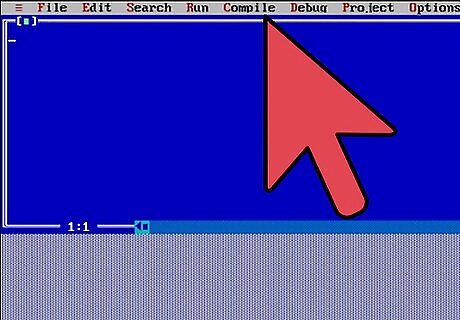
A cleaner option is to enable floating point library linking in Turbo C/ C++ or Borland C/ C++ from linker options for library to include floating point.












Comments
0 comment